
Your home’s gutter system has one primary job: managing roof runoff so water is directed away from the house. One of the most common homeowner complaints is a leaky basement—often noticed after a heavy rainstorm or during spring thaw.
Grading and Landscaping
Proper grading is typically about a 6-inch drop in height starting at the foundation over a distance of 10 feet (roughly a 2% slope). More than likely, the backfill against the foundation met this requirement at one point in time. However, after many years the ground will settle—and that’s when problems usually start.
Instead of the ground sloping away from the foundation, it can change direction and start sloping toward the foundation. Water always seeks the lowest level and will begin pooling next to the foundation. As it seeps into the ground, it can cause additional settling and make the problem worse.
Sump Pumps and Drain Tiles
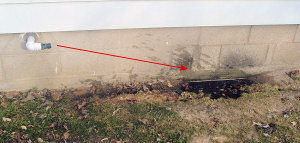
Some homes were equipped with a drain tile system installed when the home was constructed. This drainage system helps with water control and channels water that ends up around the foundation to a sump pit located in the basement.
As the water in the pit reaches a specific height, the pump turns on and pumps the water out of the pit—either into a storm drain or back onto the property through a long hose. I’ve inspected many homes where this hose has been removed and the sump pump discharges directly outside next to the foundation. That defeats the purpose and can contribute to basement moisture issues.
Gutters
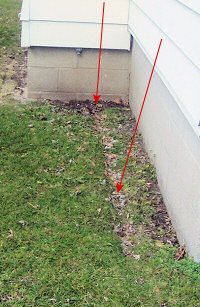
This is a typical example of soil erosion next to a foundation wall on a home with no gutters installed. Rainwater falls from the roof and hits the ground directly under the eaves. Over time, the soil settles and a trough can form.
Because water seeks the lowest level, it will pool in this trough and can eventually work its way to the foundation—and possibly into the basement. Remember, your basement is essentially a hole in the ground that is trying to keep water out. Adding more water puts unnecessary stress on foundation and basement walls.
Leaders, Extensions, and Splash Blocks
These items are located at the end of the downspout and serve two main functions: (1) channel water away from the foundation, and (2) reduce erosion of soil. Fast-moving water is very effective at moving soil.
Most gutter extensions are not fastened to the downspout and can easily be dislodged. It’s a good idea—especially in the spring—to check that all leaders are in place and not crushed. Spring rains are coming, and the goal is simple: keep water out of your basement.
Gutter Guards
If your home is in an area with many trees (or trees with small needles or leaves, like pines), gutter guards can be helpful. There are many products on the market. One product we’ve seen used is manufactured by Master Shield.
Master Shield is designed to act as a filter, separating debris from water and directing runoff through the gutter system and away from the foundation.